
Why Your Restoration Website Isn’t Generating Leads (And How to Fix It)
TL;DR: Key Takeaways
| Key SEO Concept | Why It Matters for Generating Leads |
|---|---|
| “Brochure” vs. “Lead Machine” | A “Lead Machine” website is built for one purpose: immediate conversion (calls and forms), not just providing company information. |
| Google Business Profile (GBP) | For local emergencies, your GBP is your *real* homepage. It’s the #1 driver of high-intent calls from the Google Maps pack. |
| Hyperlocal City Pages | Individual pages for each town you serve allow you to rank for specific searches (e.g., “water damage in Springfield”), capturing a wider area. |
| E-E-A-T Signals | Proving your Experience, Expertise, Authoritativeness, and Trust with reviews and certifications is crucial for ranking high in Google. |
Your website is your digital storefront, your 24/7 salesperson. At least, it’s supposed to be.
But for most restoration contractors, their website is just an expensive, online brochure. It looks nice, lists services, but the phone never rings because of it. Sound familiar?
As a “Google Alchemist”, I’ve seen the same critical mistakes made over and over. This is a no-fluff guide to fixing them. The good news is, you don’t need a complete overhaul. You just need to think less like a contractor and more like a company that provides **Real Time Lead Gen**.
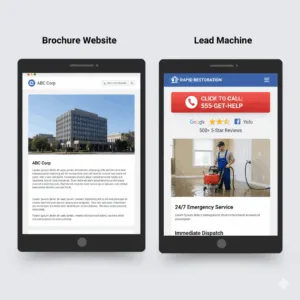
The Core Problem: Your Website is a “Brochure,” Not a “Lead Machine”
Here’s the fundamental difference: a brochure site talks all about “us”—our history, our team, our mission.
A lead machine is laser-focused on the customer’s urgent problem and provides an immediate, unmissable solution.
When a homeowner’s basement is flooding, they don’t care that your grandfather started the company in 1978. They care about the big, bold phone number at the top of your site that they can click to get immediate help.
| Feature | Typical “Brochure” Website (Low Conversion) | Effective “Lead Machine” Website (High Conversion) |
|---|---|---|
| Phone Number | Buried on the “Contact Us” page. | Click-to-call, visible at the top of EVERY page. |
| Main Headline | “Welcome to Our Website” or “About Us”. | “24/7 Emergency Water Damage Service – Call Now!”. |
| Content Focus | Our company’s history, our mission statement. | The customer’s problem and our immediate solution. |
| Customer Reviews | A hidden page with a few old, text-only testimonials. | Prominent 5-star review logos and fresh testimonials on the homepage. |
Winning Locally: Why Your Google Business Profile Is Your *Real* Homepage
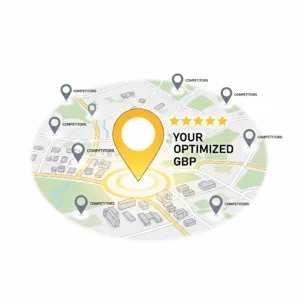
For any local emergency service, your Google Business Profile (GBP) is arguably more important than your website itself. It’s what appears in the valuable “map pack” results.
An optimized GBP is the number one trust signal for local customers. Focus obsessively on getting a steady stream of new, positive reviews. Make sure your Name, Address, and Phone number (NAP) are perfectly consistent everywhere online. Use the Q&A feature to answer common questions before they’re even asked.
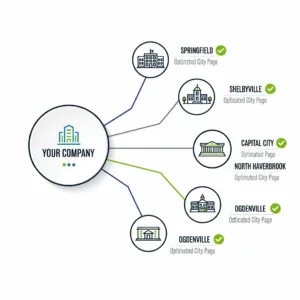
Expanding Your Reach: The Untapped Power of Hyperlocal City Pages
Do you have one “Service Areas” page that just lists a bunch of towns? For SEO, that’s almost useless.
To truly rank in the specific towns you serve, you need to build out individual “city pages.” Each page should be a dedicated resource for that specific location.
Write unique content for each page. Mention a local landmark, talk about a common issue in that area (like flooding near a specific creek), and include a testimonial from a client in that town. This shows Google you are a true local authority, not just a company that happens to serve the area.
Mastering this is a key step, but it’s just as important to know how to convert the leads you generate with a proven sales process.
Building a powerful SEO foundation is the ultimate long-term strategy for generating your own leads. For those who need the phone to ring immediately while that foundation is being built, it’s crucial to also understand a model that guarantees calls from day one.
Tired of dealing with SEO? Let us handle it. Fill out our intake form and let us make your phone ring.
P.S. Your website can be your best employee, working 24/7 to bring in profitable jobs. If it’s not, it’s broken. We build lead generation machines. Let’s talk.
Frequently Asked Questions About Restoration SEO
What is the most important part of SEO for restoration companies?
For restoration companies, the most important part of SEO is Local SEO. This means having a perfectly optimized Google Business Profile (GBP) with a high volume of recent, positive reviews. Ranking in the local “map pack” for emergency search terms will generate more high-quality calls than anything else. You can see how **Real Time Lead Gen** has established its entity online as an example.

What is E-E-A-T for contractors?
E-E-A-T (Experience, Expertise, Authoritativeness, Trust) for contractors means proving to Google and potential customers that you are a legitimate, skilled, and trustworthy professional. This is done by showcasing real-world experience (before/after photos of local jobs), expertise (IICRC certifications), authoritativeness (being featured in local news), and trust (customer reviews, clear contact information).
Do I need a blog on my restoration website?
Yes, a blog is highly beneficial. It allows you to create helpful content that answers your customers’ questions (e.g., “what to do after a pipe bursts”), demonstrates your expertise, and provides opportunities to rank for a wider range of keywords. Each helpful post builds your site’s overall authority on the topic of water damage restoration.
Why don’t “Service Area” pages work for SEO?
A single “Service Area” page that simply lists dozens of towns is not effective because it isn’t specific enough to rank for searches like “water damage in [Specific Town]”. Google wants to show the most relevant result, which is a page dedicated to that specific town. Creating individual, hyperlocal “city pages” is the correct and more powerful strategy.
150 E 10th St
Bloomsburg, PA 17815
(570) 634-5885
[email protected]

Justin Hess, Founder & Google Alchemist