
Hump Day Lead Triage (Owner + Dispatcher Edition): The 20-Minute Midweek Fix That Stops You From Missing Water Damage Jobs

TL;DR
| Hump Day Triage Item | Owner Focus (System) | Dispatcher Focus (Execution) | “Done” Looks Like |
|---|---|---|---|
| Live Answer Chain (no missed calls) | Build a multi-layer live-answer routing chain (office → on-call → overflow live answer / warm transfer). | Answer immediately with control; never let the caller “bounce.” | 100% of water calls reach a human in seconds. |
| First 30 Seconds | Train + QA the opener; enforce “address first” + commitment language. | Calm the caller, get address, confirm active flow, start containment. | Caller stays on the line and follows your lead. |
| Calm → Contain → Commit Script | Standardize the script across everyone; review 5 calls/week. | Ask only what changes immediate action; book a window. | You commit a dispatch/inspection window on viable calls. |
| Routing Redundancy (after-hours included) | Test after-hours routing every Wednesday; ensure on-call is reachable. | Same script and confidence after-hours; no “maybe” language. | After-hours calls convert like business hours. |
| Wednesday Scoreboard KPIs | Track: Live Answer Rate, Speed-to-Answer, Commit Rate, After-Hours Reliability, Capacity Truth. | Execute to the KPIs: speed + structure + commitment. | One KPI improves by Friday (not next month). |
| Trust Stack (process > hype) | Maintain proof assets (before/after, “first hour” video, documentation explainers). | Use trust phrases: “stop damage first, document, start drying.” | Caller feels safe choosing you quickly. |
| Wed → Fri Surge Plan | Confirm staffing/equipment/rentals; define priority rules for active water flow. | Book specific windows, keep instructions simple (1 action at a time). | You handle weekend surge without chaos or missed jobs. |
It’s Wednesday—Hump Day—which makes it the best day of the week to tighten the bolts before the weekend chaos hits. In restoration, the biggest “marketing problem” usually isn’t marketing… it’s operations on the phone.
Here’s the hard truth: in a flooded basement or a burst pipe spraying everywhere, homeowners are not “waiting for a callback.” If the call isn’t answered live, the job usually goes to whoever did.
This post is intentionally hybrid: it gives owners the system to build, and gives dispatchers the exact execution that converts a chaotic emergency call into a booked dispatch (or scheduled inspection) fast.
Want exclusive, real-time water damage calls—and a cleaner pipeline to convert them?
1) The 20-Second “Live Answer” Reality Check (5 minutes)
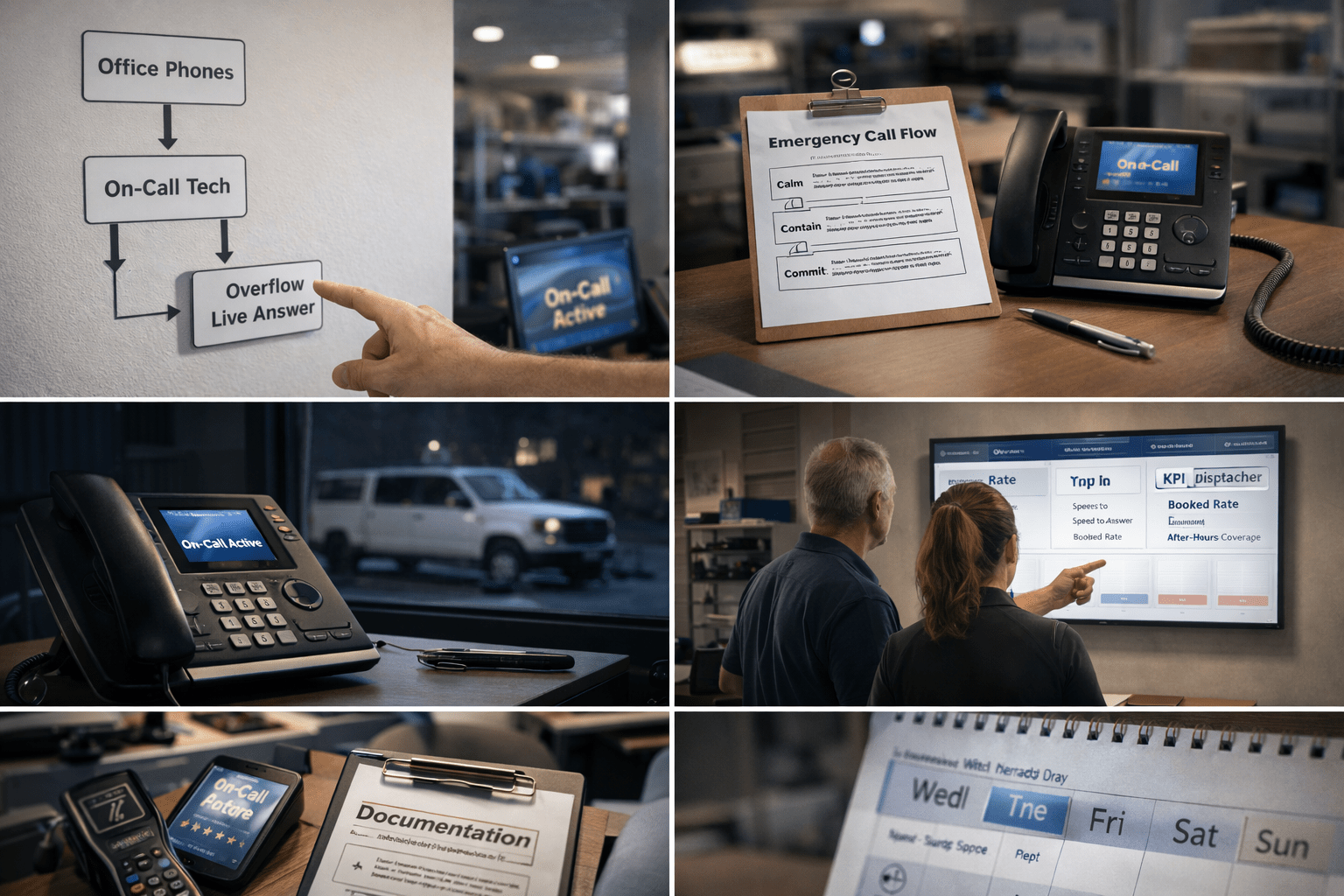
Goal: confirm that every water damage call gets a human—immediately—no voicemail, no “we’ll call you back,” no dead ends.
The question (ask it out loud): “If a homeowner calls right now with water pouring through a ceiling… what happens in the next 20 seconds?”
Owner: build a Live Answer Chain (non-negotiable)
- Layer A (Business Hours): primary office ring group (2+ people if possible), owner backup, and a designated lunch/meeting float.
- Layer B (After Hours): on-call tech (reachable), owner backup, overflow live answer (answering service with warm transfer or managed overflow).
- Layer C (Last resort): routing to a backup restoration partner is better than a missed call, but should motivate you to strengthen Layer B.
Dispatcher: the 10-second “control the call” opener
- “You called the right place—we handle water emergencies.”
- “Are you safe right now?”
- “What’s the address?”
- “Is the water still running or has it stopped?”
2) The “Calm → Contain → Commit” Script (7 minutes)
This is the script that turns panic into a booked dispatch—fast—without sounding robotic.
Calm
- “I’m going to help you right now.”
- “We do this all the time. We’ll get it under control.”
- “First, I need the address so we can dispatch correctly.”
Contain (only what changes immediate action)
- “Is water still actively flowing?”
- “Where is it coming from—pipe, appliance, drain/overflow, roof, or unknown?”
- “Any water near outlets or the breaker panel?”
- “What areas are affected?”
- “Could it be contaminated (sewage/gray/unknown)?”
Commit (book the window)
- “We can have a crew there between [X–Y]. Does that work?”
- “I’m going to lock that in—what’s the best number to reach you on?”
- “We’ll arrive, stop further damage, document everything, and start the drying plan.”
3) Routing Redundancy That Matches Emergency Physics (6 minutes)
Water emergencies don’t respect office hours. Your routing needs layers that survive predictable failures: office busy, tech unreachable, owner driving, weak signal.
Owner checklist
- At least 2 humans in the ring group during business hours (or 1 + overflow).
- After-hours always has a designated primary + backup.
- Test after-hours routing every Wednesday.
- Confirm overflow can warm transfer if you use one.
If you run Google LSAs
Review lead quality regularly, rate/dispute appropriately, and understand how credits may be applied over time per Google’s documentation.
Fix the pipeline first—then scale
4) The Wednesday Scoreboard: 5 KPIs That Actually Matter (7 minutes)
- Live Answer Rate: treat anything below “near 100%” as a leak.
- Speed to Answer: seconds to human + quality of first 30 seconds.
- Commit Rate: dispatch/inspection window agreed (or clear disposition).
- After-Hours Reliability: tested weekly (Wednesday).
- Capacity Truth: crews + equipment + extraction reality.
5) Trust Stack: Reviews Still Matter, But Process Trust Wins Emergencies (6 minutes)
Homeowners decide fast in emergencies. You win by sounding like the company that has done this 1,000 times—and proving you have a process.
Owner assets
- 3 recent before/after photos
- 1 short “first hour” video
- What-to-expect one-pager
- Documentation + drying plan explanation
Dispatcher phrases
- “We’ll stop further damage first.”
- “We’ll document everything and guide you step-by-step.”
- “We’ll send an ETA window and next steps.”
6) Wednesday-to-Friday Surge Plan (Owner + Dispatcher) (7 minutes)
Owner: surge preparation
- Confirm on-call schedule is reachable and accountable.
- Stage gear and verify equipment inventory.
- Confirm subcontract/rental options for capacity spikes.
- Define “priority call” rules for active water flow.
Dispatcher: surge execution
- Book specific windows (“2–4pm”), not vague promises.
- Repeat the plan: “Stop damage, document, start drying.”
- Keep containment steps simple: one action at a time.
Ready for exclusive, real-time water damage calls?
- Intake
- Call/Text:(570) 634-5885
- justin@realtimeleadgen.com